Is Temu a Scam or Not? an Honest 2026 Shopper's Guide
By Josh C.
Temu is a real, operating marketplace under PDD Holdings, not a fake storefront that only steals payments, but its third-party seller model and documented regulatory actions mean individual listings carry heightened risk. By 2023 the app had roughly 337 million global downloads, and in September 2025 the U.S. Federal Trade Commission announced a $2 million settlement with Whaleco, Temu's operator.
If a checkout page takes your card and a parcel shows up, does that settle whether Temu is a scam or not? A lot of shoppers treat delivery as the whole test. Families watching an older relative's phone know the harder problem starts earlier, in the listing, the countdown timer, and the seller you can't quite identify.
Why the Temu Scam Question Is Harder Than It Looks
People use scam for three different failures, and Temu matches some of them and misses others.
A fake storefront takes payment and never ships. A deceptive retailer ships something while the price, the review, or the deadline was misleading. A weak marketplace is a real company that still lets unreliable sellers list goods. Mixing those meanings is why a flat yes or no feels unsatisfying. You can hold a package and still have been misled about what you bought.
This piece separates three questions.
Is the company real? That is about whether orders are processed by an operating business with a public parent, not a site built only to harvest cards.
Are the practices deceptive? That is about discounts, urgency messages, reviews, return rules, and how hard it is to reach a human.
Is this listing safe? That is about the seller behind one product, the category, and whether you could identify that seller if the item is fake, unsafe, or never what the photo showed.
The trail is documentary, not a vibe check. European consumer authorities have put Temu on formal notice. The European Commission has examined product-safety systems under the Digital Services Act. U.S. complaint files and a later marketplace-disclosure case show friction that ordinary shipping delays don't explain. Scale figures show the opposite of a ghost shop. None of those records, on their own, convict every order or clear every listing.
Practical rule: Judge the company, the promotion, and the seller as three separate risks. A real checkout doesn't certify the product.
The split matters most when one household shares a card or an app login. Gamified offers and short deadlines can push repeat taps even when each charge is a genuine order. Caregivers need a way to tell a legitimate bargain from a listing they shouldn't trust, and a plan for the afternoon something arrives wrong.
The Evidence That Temu Is a Real Marketplace
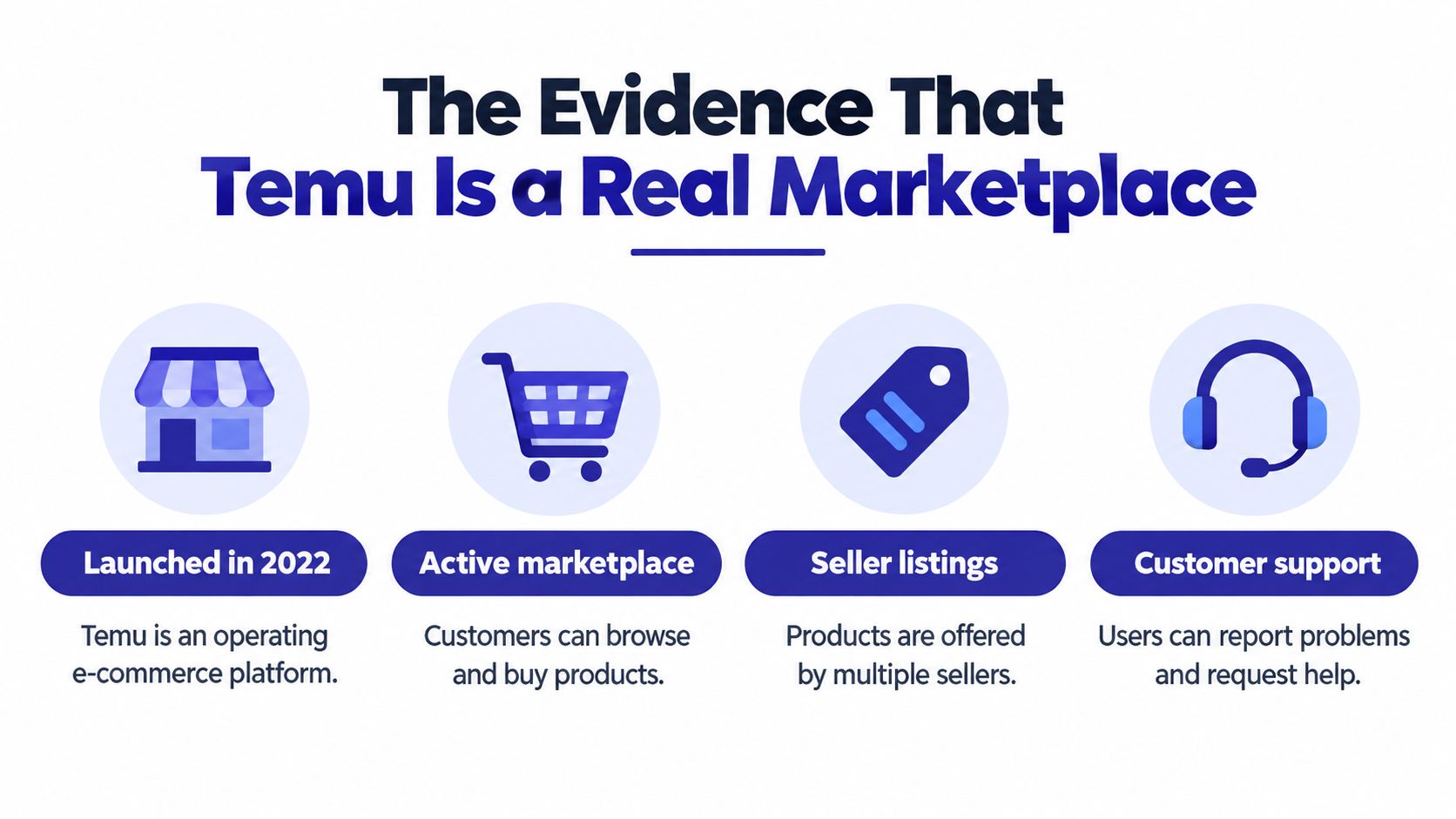
Could a storefront built only to steal payment details attract a large base of shoppers and sellers? Temu launched internationally in 2022 under PDD Holdings, the publicly traded parent associated with Pinduoduo, according to Temu's company history. Its operation as a marketplace is evidence against a pure fake-storefront theory, though it does not establish that every listing or seller is trustworthy.
What the scale numbers can prove
The original claims about app downloads, U.S. users, and monthly sales lack named sources and dates that would let readers assess them. Without that context, precise figures cannot establish how large the marketplace is or how quickly it grew.
The broader evidence is that Temu functions as a marketplace where buyers place orders and sellers list goods. That makes the idea of a site existing solely to harvest card details harder to support. A functioning platform can still have misleading promotions, unresolved disputes, or unreliable sellers. Its scale speaks to the reality of the business, not the safety of a particular purchase.
What the same evidence doesn't prove
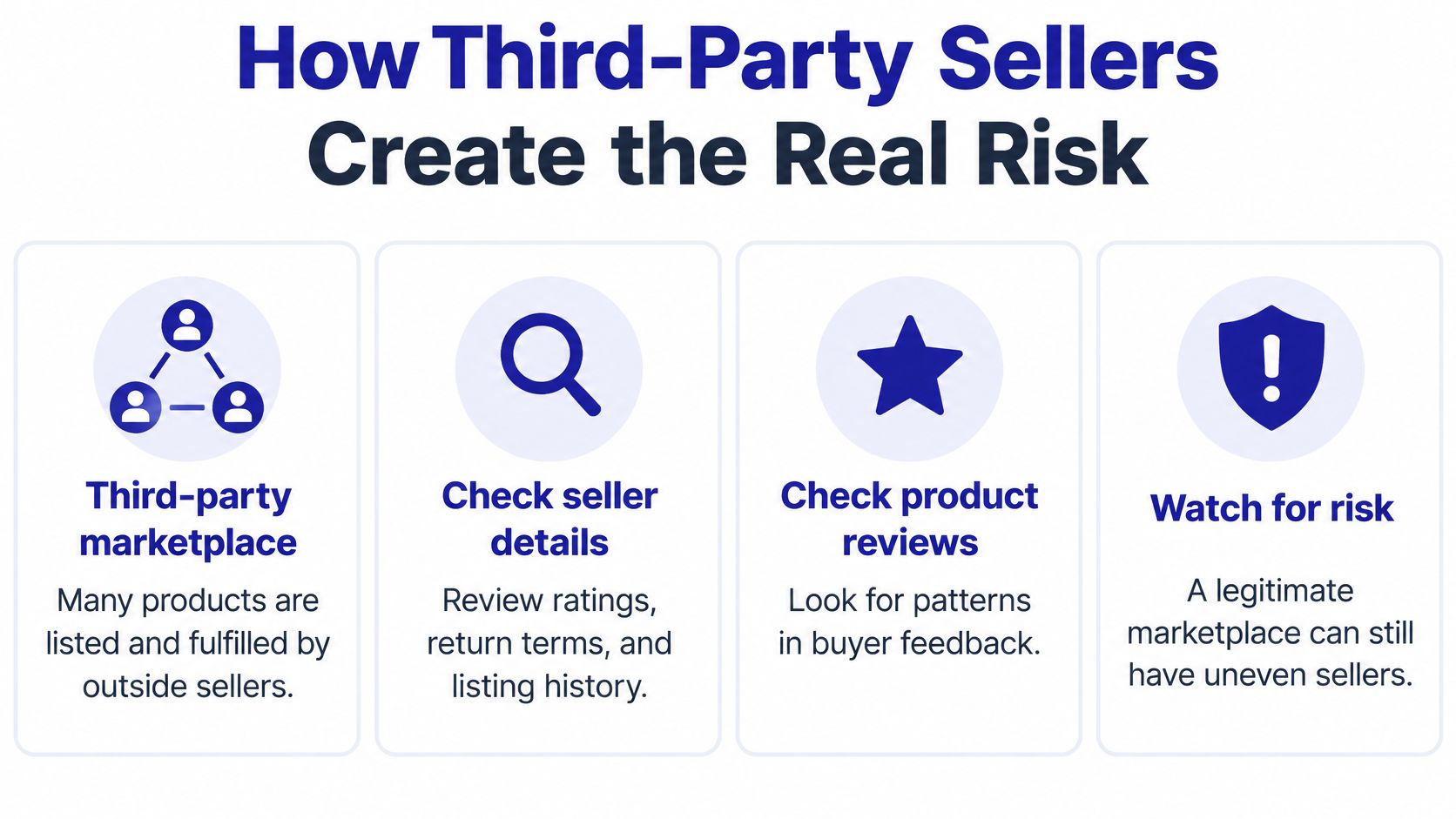
Temu is primarily a third-party marketplace. Many products are listed or shipped by independent sellers, rather than made or supplied by Temu itself. As a result, quality, delivery, refunds, customer service, and seller reliability can vary. A real order may still arrive damaged, differ from its listing, or fail to arrive.
Low prices can reflect cross-border, factory-direct selling, which may avoid some markups found on domestic retail sites. That model also leaves shoppers assessing individual listings and sellers rather than relying on the platform's existence as a quality guarantee. Treat Temu's operation as evidence that it is a real marketplace, then weigh the seller, product details, and terms of the specific listing.
What Regulators and Complaint Data Actually Show
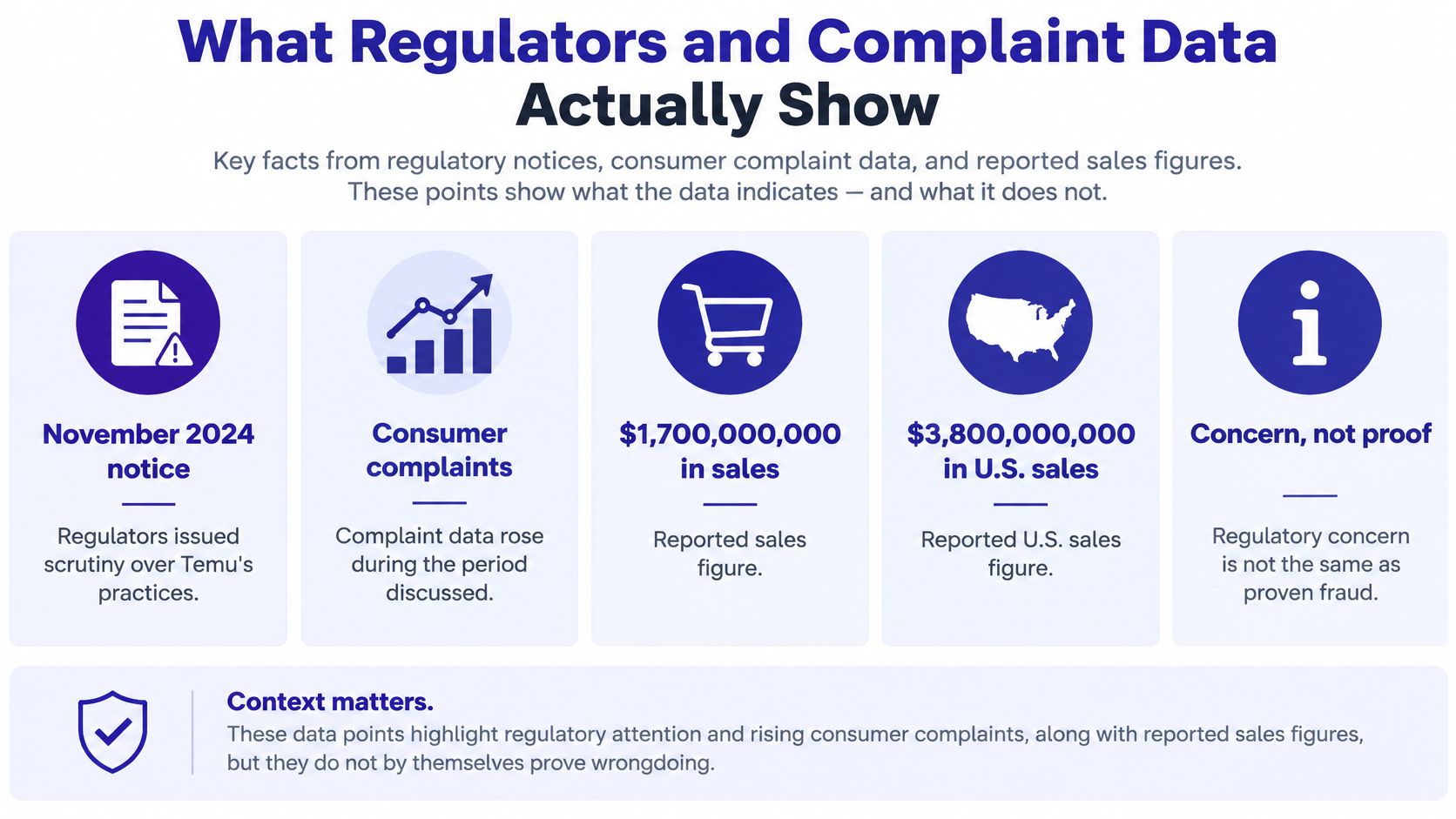
What can complaints and regulatory findings establish about Temu? They point to concerns about marketplace practices and product compliance, but they do not prove that every purchase is fraudulent.
The European notice and the product-safety case
In November 2024, the European Consumer Protection Cooperation Network notified Temu that several marketplace practices could breach EU consumer law, according to Britannica's Temu briefing. The concerns included alleged fake discounts, pressure-selling through limited-supply or deadline messages, forced gamification, unclear return and refund information, minimum-order requirements, suspected inauthentic reviews, and contact details that were difficult to find.
The European Commission had opened a formal Digital Services Act investigation in October 2024 into Temu's systems for limiting illegal or non-compliant products. In a later preliminary finding, the Commission said consumers faced a high risk of encountering such goods, including baby toys and small electronics. It also said Temu's risk assessment relied on general industry information rather than evidence specific to its marketplace, potentially weakening its mitigation measures, according to the Commission's preliminary DSA findings.
These are regulatory concerns, not a final court judgment. They focus on platform design and product controls, rather than proving that any particular order was a scam.
What the complaint file does and doesn't say
The available account of U.S. Federal Trade Commission complaints does not identify a linked dataset supporting its reported count or share of shopping-related complaints. Those figures therefore cannot establish how common Temu-related problems are. Complaints also do not prove fraud: a report may concern a delayed refund, an item that differs from its photo, or difficulty reaching support, and a complaint can remain unresolved.
The regulatory actions offer a firmer basis for concern than an unsourced complaint tally. Taken together, they raise questions about promotions, product compliance, reviews, and consumers' ability to seek recourse. They do not establish that every Temu charge is theft, or that every listing carries the same level of risk. The platform's legitimacy and the reliability of an individual listing are separate questions.
How Third-Party Sellers Create the Real Risk
The company can be legitimate while a single listing is a bad bet. That gap is structural.
Temu doesn't manufacture most of what you see. Independent sellers list and ship a large share of the catalog. One seller's photos, packing, and refund habits don't bind the next seller. You can have a smooth order on Monday and a mismatched gadget on Friday without the platform having turned into a fake shop overnight.
Why missing seller identity changes the purchase
In September 2025 the FTC announced a $2 million settlement with Whaleco, Temu's operator, over alleged violations of the INFORM Consumers Act. The allegations included failing to provide required seller information and adequate tools for consumers to identify and report stolen, counterfeit, or unsafe goods, the FTC's settlement announcement states.
Read that as a marketplace-integrity failure, not proof that every order is fraudulent. The chain is simple. Incomplete seller disclosure weakens traceability. Weak traceability makes it harder to tell an authorized product from a counterfeit before you pay, and harder to get a remedy after. A box on the porch doesn't prove the item is genuine, compliant, or safe.
A short check before you tap buy
Don't treat every category the same.
- Branded electronics, cosmetics, batteries, children's products, and safety gear: Treat unusually cheap versions as high risk. A low price can be a supply-chain bargain or a non-compliant copy. You often can't tell from the thumbnail.
- Seller identity: Look for a name you can clearly read, not just a store nickname. If you couldn't report that seller tomorrow, skip the listing.
- Reviews: Scan for repeated phrasing and reviews that don't match the product. Stars alone aren't a safety test.
- Payment: Use a credit card or a virtual card, and don't store the credential in the app.
Photos can be stolen or generated. A practical companion to reading reviews is fraud prevention with AI Image Detector, which walks through how manipulated product images show up in online stores. Broader warning signs of lookalike shops are covered in this guide to online store scams.
If you wouldn't hand the item to a child or plug it in unsupervised, don't buy it from a seller you can't name.
Comparing Buyer Protections and Scam-Screening Tools
Paying with a protected card is necessary. It isn't the whole shield. Each layer covers a different failure, and each one has a hole.
| Protection Layer | What It Covers | Key Limitation |
|---|---|---|
| Temu's internal dispute process | Wrong, missing, or not-as-described items filed inside the app | Depends on the listing still being visible and on seller records the platform may not show clearly |
| Credit card chargeback | Unauthorized or undelivered charges, and some quality disputes, through your issuer | Deadlines are strict, and a delivered counterfeit can be harder to win than a charge that never shipped |
| Virtual card or credential hygiene | Limits how much a stored card number can be reused | Doesn't inspect the product or identify the seller |
| Scam-screening on calls, texts, and email | Fake support messages and purchase-pressure calls that arrive after you shop | Doesn't refund the order or test whether a toy or charger is compliant |
How to stack them instead of picking one
Start inside the app so you have a case number. If the internal path stalls, the card issuer is the next clock that actually matters. A virtual card keeps a compromised login from becoming a second purchase. None of those steps stop a text that pretends to be support and asks you to "confirm" the card.
That last gap is where a screener fits. Gini Help is an AI-powered protection service that screens calls, texts, and emails and blocks spam and scams before they reach you. It uses fine-tuned language models to judge a caller in the moment, rather than matching a database of known spam numbers that callers rotate out of. One app covers phone calls, email (Gmail, Outlook, Yahoo, and iCloud), and SMS. Live Call Analysis gives a risk score and haptic warnings on calls you do answer. The service launched in December 2025 and costs $5.99 per month, with family plans that share threat intelligence across members.
For a household, that matters because shopping apps and lookalike support lines travel together. A relative can place a legitimate order and still get a follow-up call that isn't the store. You can get it on Google Play or the App Store. Pair the app with habits from this piece on safer online shopping: protected payment, no stored card, and a second look at urgency banners.
What to Do When a Temu Purchase Goes Wrong
What can you do when an order is misrepresented, never arrives, or leaves you with an unsafe item? A card helps, but a timely dispute also depends on records identifying the seller, the listing, and the transaction.
Build the file before you argue
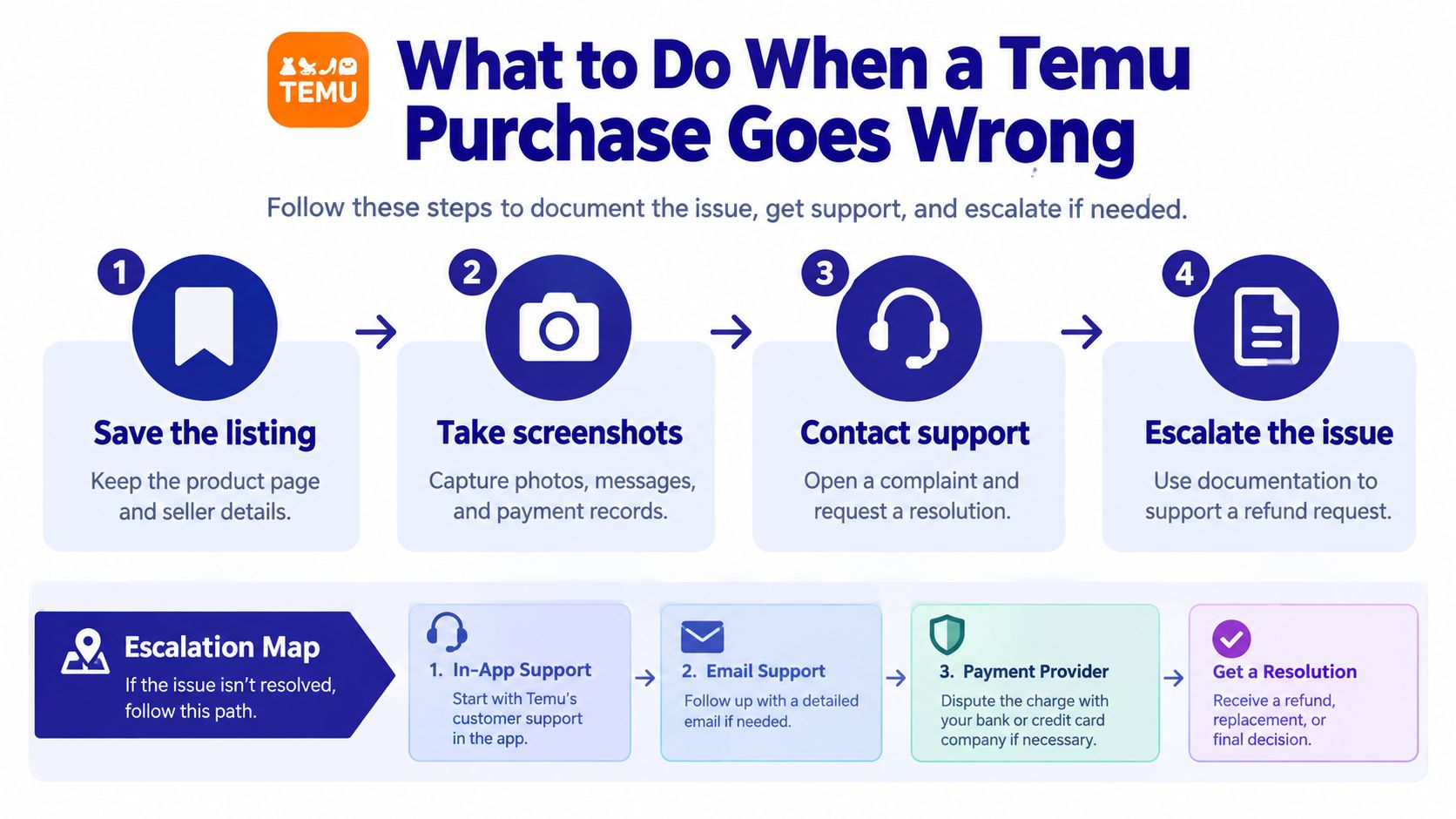
Save the product page, seller name, price, shipping promise, and chats. Screenshot the order confirmation and payment charge, then photograph the item beside the listing. Do this before requesting a return. Listings can disappear, and support staff may ask for details that are no longer visible.
The U.S. Federal Trade Commission alleged that Temu failed to provide required seller disclosures and did not consistently offer reporting methods required under the INFORM Consumers Act, including a phone-based method for some listings. The FTC's enforcement blog on the INFORM Act case explains the agency's allegations. For shoppers, the practical point is to preserve seller details, screenshots, and shipping records, particularly when reporting a suspected counterfeit, non-delivery, or misleading listing.
Escalate in order
- Open Temu's dispute first. Request a refund or replacement in writing through the app, and save the case number.
- Contact your card issuer before its deadline. Don't let a slow support exchange run out the time to dispute the charge. Provide the saved records, not just a summary from memory.
- Report counterfeit or unsafe goods to your national consumer or product-safety authority. A refund resolves your order, but it does not remove a dangerous item from the wider catalog.
Watch for repeat purchases as well as a single bad parcel. Repeated unwanted orders or add-on charges may indicate that a problem extends beyond the product itself. If an add-on or subscription charge is involved, the subscription refund request guide offers a model for a concise written request. If you cannot reach the seller and the money is already gone, follow this guide on how to recover money from a scammer to organize the payment dispute and supporting records.
Account alerts can help catch unwanted repeat charges. Countdown deals may encourage another purchase, so check the order history and payment activity rather than relying on memory.
Families can turn on purchase notifications and review order history together. The aim is to spot a pattern early, not to ban the app.
The Verdict and Your Next Steps as a Temu Shopper
Temu is a real retailer that delivers goods. It isn't a conventional scam that exists only to take a payment and vanish. Shoppers still face higher risk around misleading promotions, product compliance, counterfeits, privacy, refunds, and seller quality. Treating every order as either perfectly safe or automatically fraudulent is the mistake.
Use it for low-consequence goods you can inspect before anyone relies on them. Skip unusually cheap branded electronics, cosmetics, batteries, kids' products, and safety equipment unless you can name the seller and stand behind the item. Don't trust reviews alone. Pay with a credit card or a virtual card, don't store the number, and keep the listing, the chats, and the receipt.
Older adults and the people who help them should watch the design, not only the merchandise. Spin-style rewards and fake urgency can drive another purchase even when the last package was fine. Shared logins, purchase alerts, and a habit of waiting overnight cut that loop without requiring anyone to quit online shopping.
If a listing fails the seller test, walk away. If an order fails after you paid, use the file you saved, the in-app dispute, the card deadline, and the national authority, in that order.
Shopping scams don't stop at the checkout page. They show up as fake support calls, refund texts, and emails that pressure a second payment. Gini Help screens those calls, texts, and emails before they reach you, which is the gap a card dispute never covers. If you want that screen for yourself or for a parent who shops on marketplaces, visit Gini Help.